
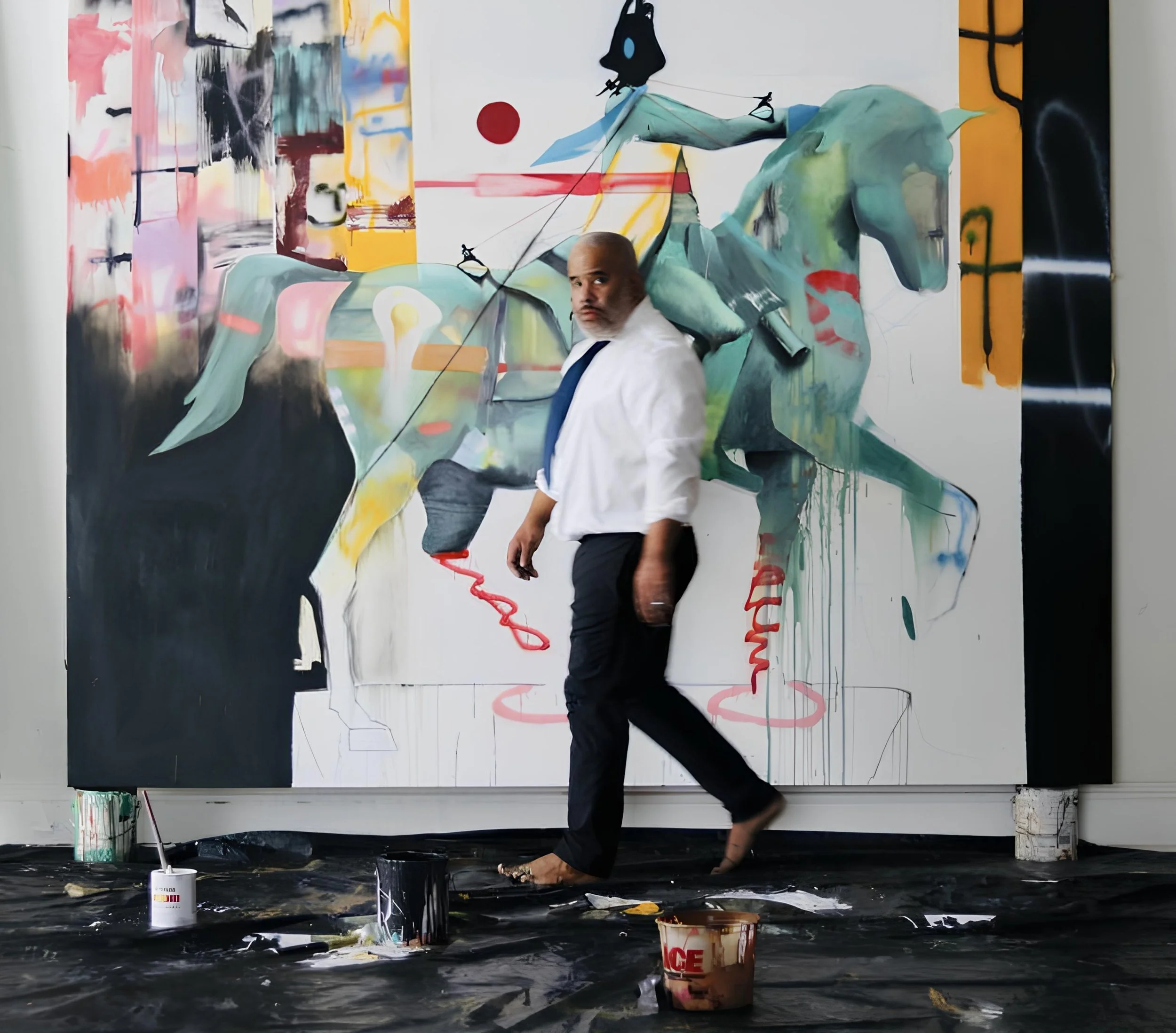
MARCUS JANSEN
Born in East Harlem and raised between the Bronx and post-war Germany, artist Marcus Antonius Jansen paints the social and political forces that shape modern life. Working in house paint, acrylics, and oil stick on monumental canvases, he builds landscapes that carry the cumulative impact of racial violence, colonial inheritance, and economic inequality. Through faceless figures and aerial perspectives, he builds a visual language that keeps meaning deliberately open. Jansen approaches history not as a fixed record but as an ongoing argument, one that demands to be reexamined through the perspectives that power has consistently worked to silence or erase. His work asks what it means to paint from inside the very history you are interrogating, treating the canvas not as documentation but as a form of resistance.
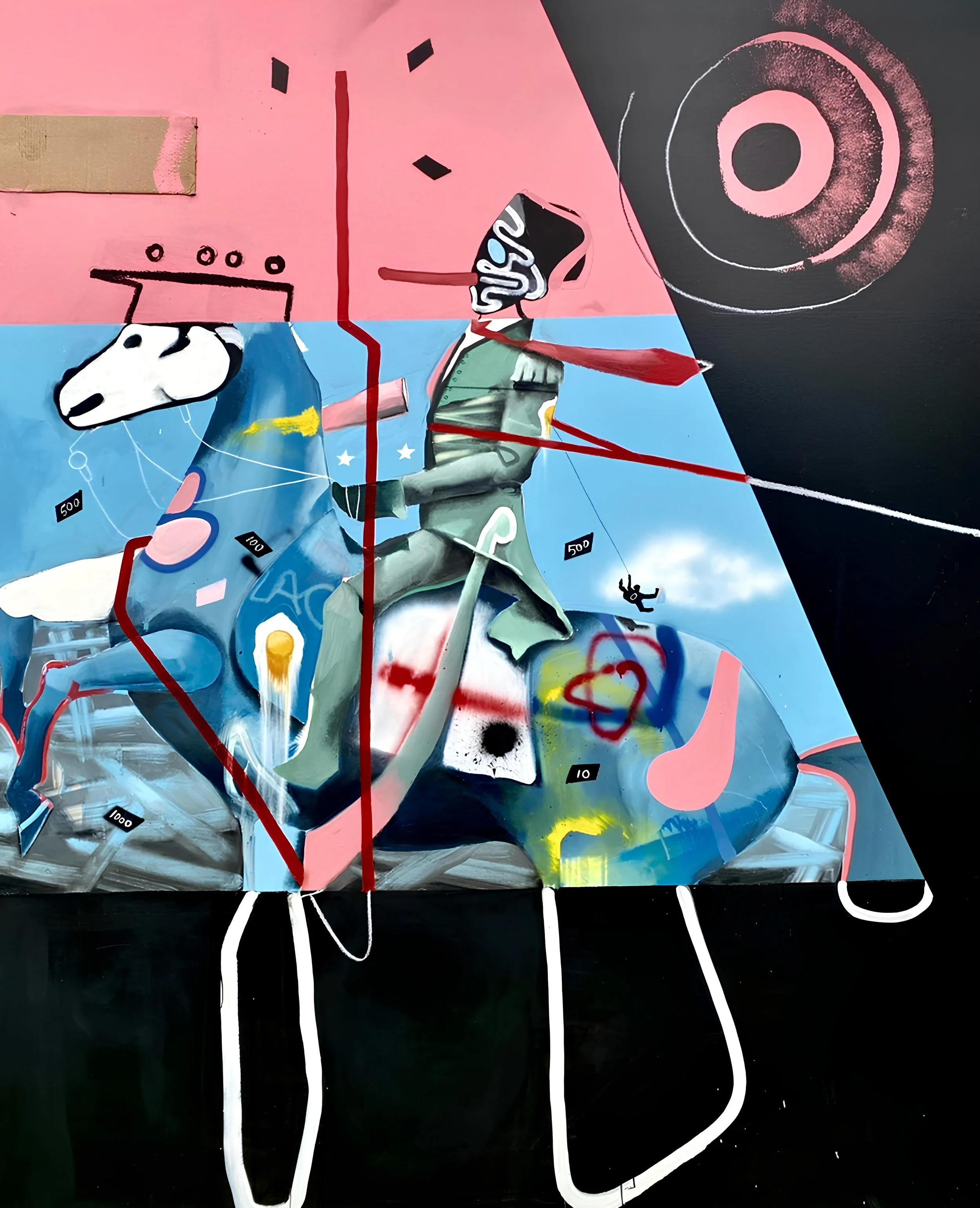
Falling Empire
“My work is a response to a contemporary geopolitical world while deconstructing longheld myths and visual narratives, painterly and historically with a focus on re-examining colonial power structures that have been used to uphold and promote empire. In my work the empire crumbles and reshapes itself into new compositions for viewers reconsideration.”
The first time I came across your work, I was immediately drawn to the historical forces living inside each canvas. Can you describe the moment art shifted from an interest to a calling for you?
MJ— As far as I can consciously trace it, my first moment may have been when I was six years old in school. Local schools were competing in a citywide art competition, with selected works exhibited at the Lever House in Manhattan, which in the 1970s was already a strong supporter of the arts and has remained so to this day. I painted a picture of a lion that was chosen for my first exhibition. I still remember the feeling it gave me. The second defining moment undoubtedly came in the 1980s, when I was introduced to graffiti writing as part of a cultural movement in New York City. It transformed the way I saw my environment, and I fell in love with its free, rebellious, activist spirit as a form of communication and expression. It became an active calling while I was searching for identity.
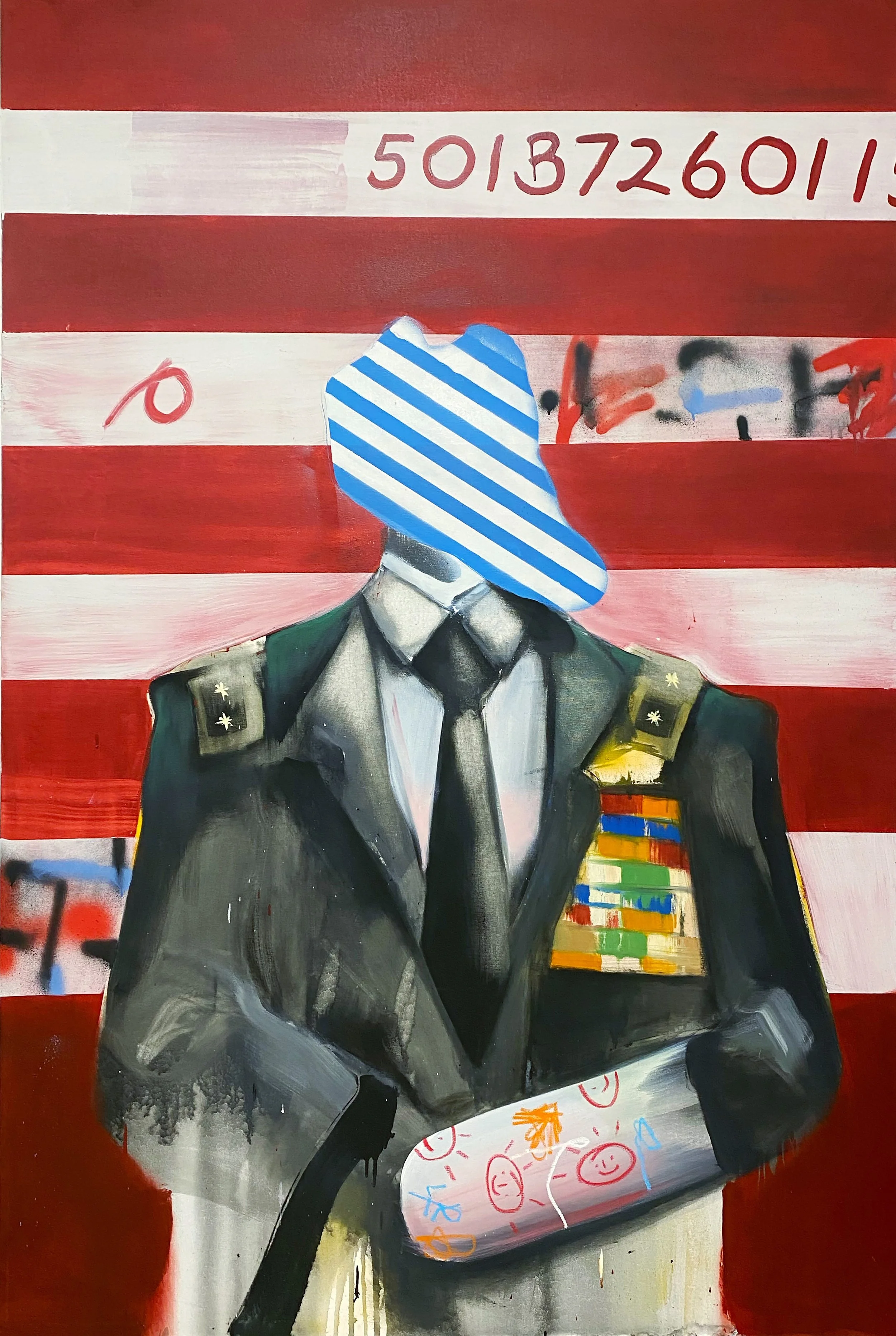
Ready for Battle
When I look at your work, I see influences of graffiti, expressionism, political portraiture, and assemblage. How did those influences find each other, and do you see them as distinct or as one continuous vocabulary?
MJ— I see them as an evolving, continuous vocabulary. I also feel they overlap, with an activist spirit underlying all of them. I grew up listening to Bob Marley and the Wailers at home. Later in life, I connected with Rastafarian beliefs, which critically examine colonial and biblical narratives. Then came hip hop, which might be one of the most anti-colonial modern forms of music created in my generation. Everything about it challenged those power structures.
Both of these movements connected me to my roots, as did the German Expressionist paintings I was exposed to in Germany. Those artists resisted conformity and taught me how to use sophistication in painting as a tool to convey complex imagery and ideas, something European audiences in particular gravitated toward. So I decided to incorporate their vocabulary.
With these layered and often conflicting influences, I frequently felt misunderstood in different settings, caught between perspectives. Art became a way to bridge those divides. It offered me another language and a different kind of tool to choose from.
Most artists who critique systems of power do so from the outside looking in. Between your upbringing and your military service, you were on the inside. How does that change what ends up on the canvas?
MJ— I’ve often been asked this, especially when exhibiting in France how I transitioned from being a soldier to becoming a full-time artist in 1997, after first painting in Army barracks. It began as a personal search for truth and self-knowledge that gradually evolved into social commentary, where one question led to another.
Growing up around U.S. Army bases in Germany during my adolescence, many of my friends were GIs. I often heard the military described as a kind of ‘socialist’ structure one that provides meals, healthcare, and education through taxpayer funding, as many developed societies aim to do. That idea appealed to me at the time, especially in what was considered a more or less ‘peacetime’ army in the late 1980s.
When I approach my practice, I bring these paradoxes into the work, using painting to deconstruct both visual language and historical narratives in search of new forms of understanding and possibility.
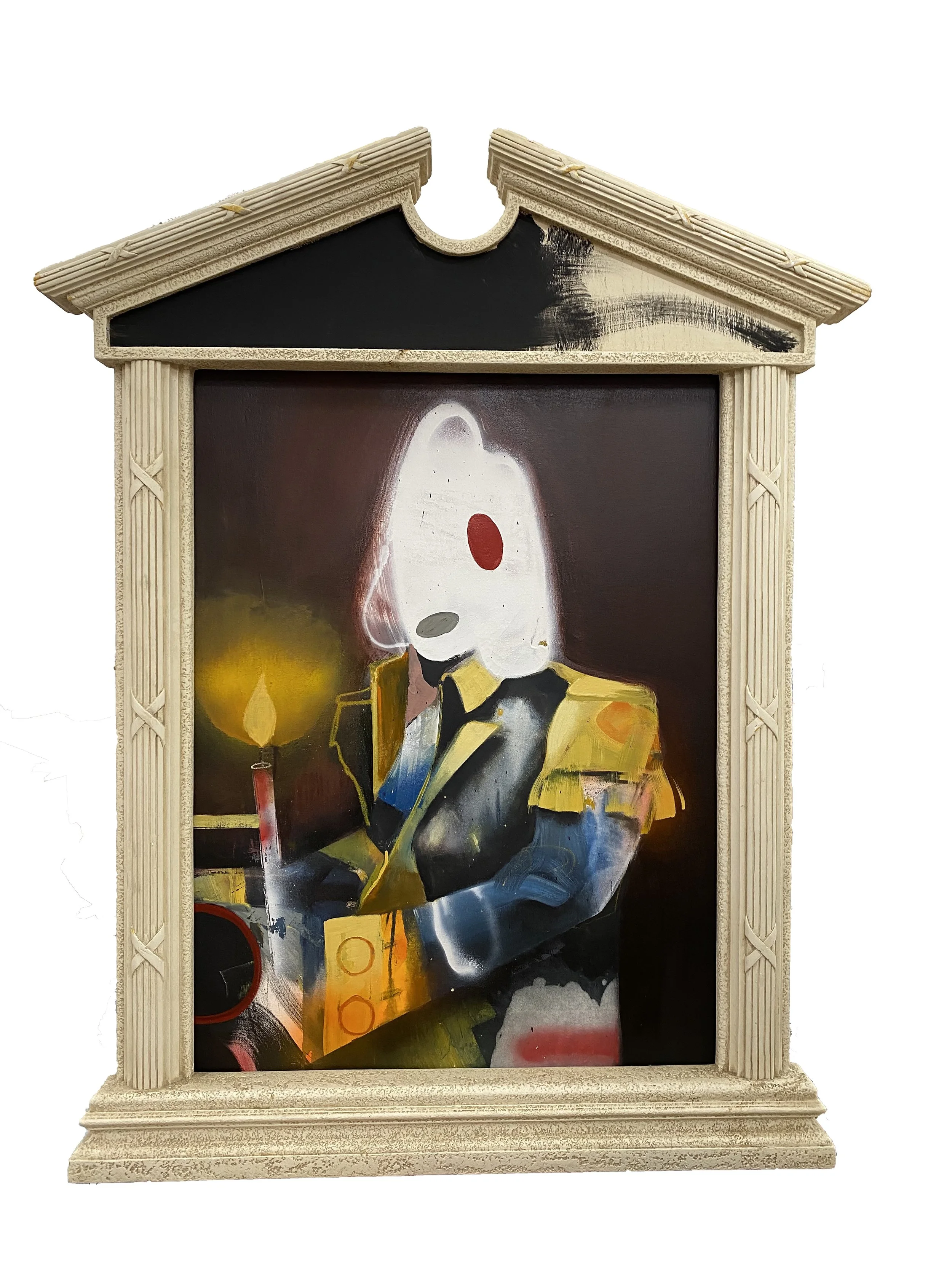
When the House is on Fire
The faceless figure is something I am really drawn to in your paintings. It holds so much interpretation and symbolism. What does the absence of a face allow you to say that an actual face would prevent?
MJ— For me, absence can speak louder than articulation. The missing face sparks immediate questions and can be understood as a kind of void or mask one beneath which the psychological and racial dimensions of colonization are concealed. Frantz Fanon has been essential reading in this regard; he was one of the few psychiatrists from the Caribbean to closely examine these dynamics.
In my work, the removal of the face also engages with and interrogates whiteness, a structure that largely emerged in the late 1600s after Bacon’s Rebellion, when racial hierarchies were formalized in the United States. I often draw from portraits of that period and revisit them. This challenges the tradition of polished, realistic portraiture we see in museums particularly of European and American men where figures are presented as heroes without questioning who they are or at whose expense those narratives were constructed.
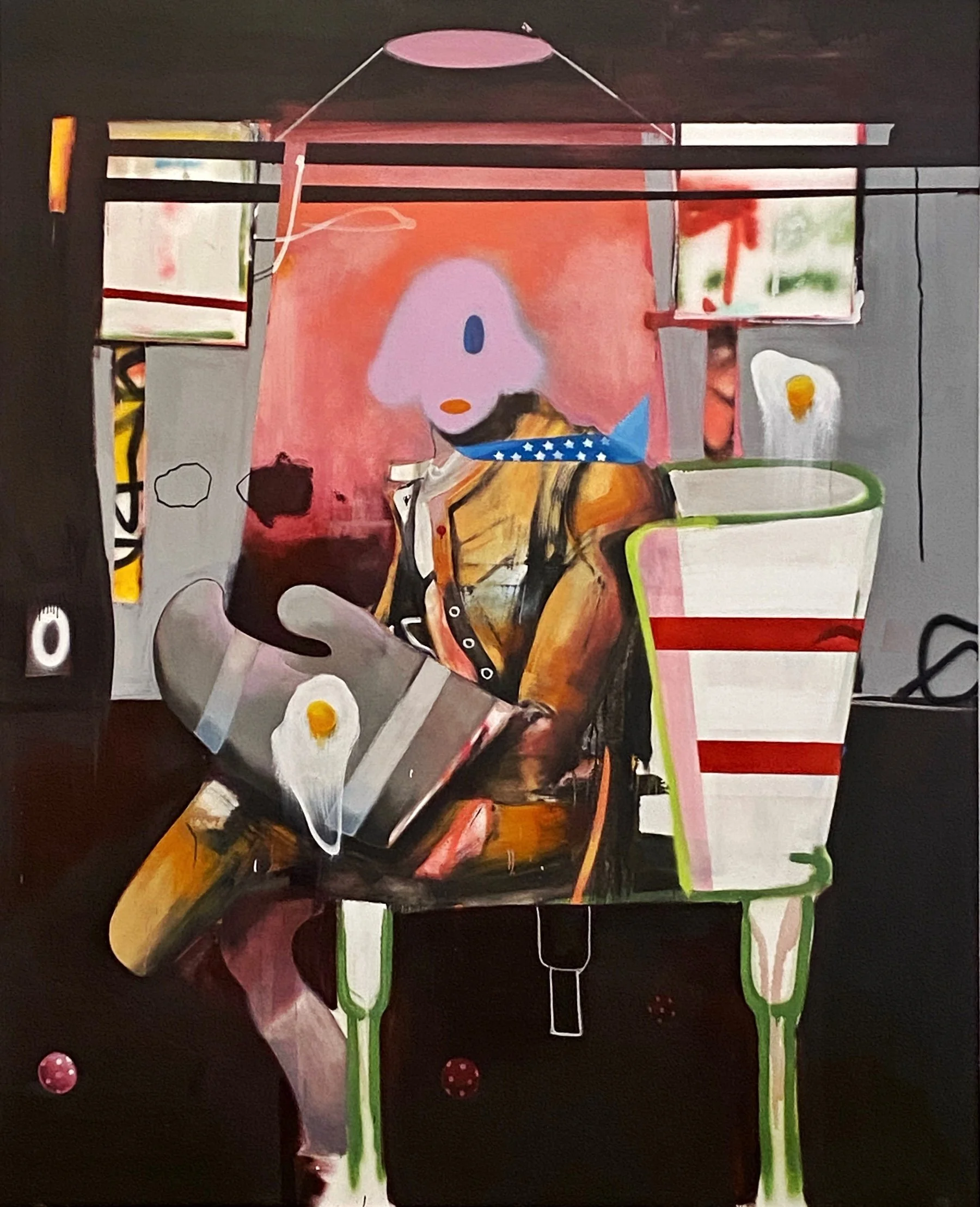
Cripped Chef
“I believe we are witnessing the gradual exposure and unraveling of colonial systems that have shaped the global order, while also entering a new phase driven by technology.”
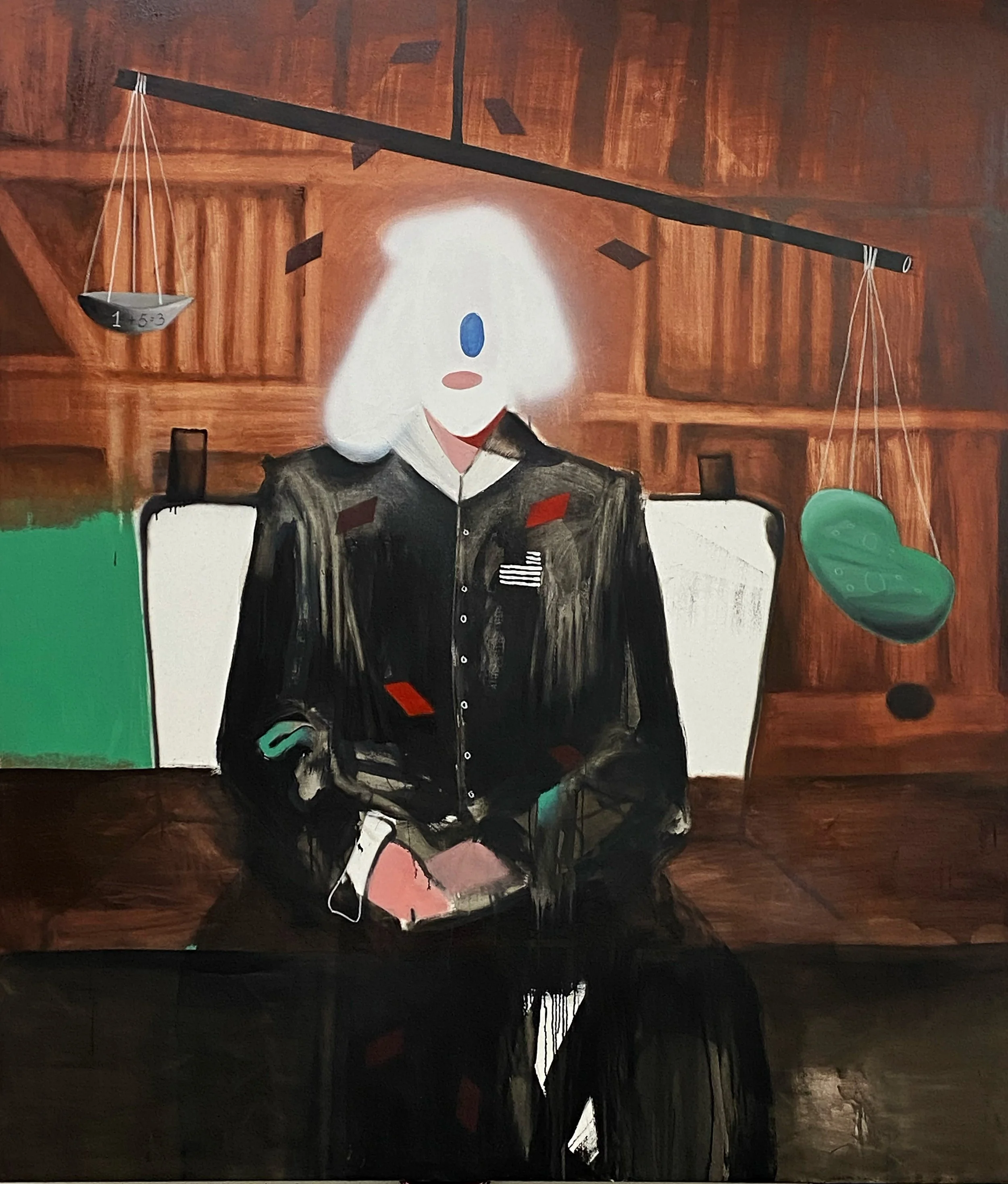
A Fair and Balanced Judge
Your work has spent decades interrogating colonial power structures. If that architecture came down, what does the world on the other side look like?
MJ— For me, interrogating colonization means examining its psychological, economic, religious, and racial dimensions especially the ways it shapes our minds and behaviors, both toward others and toward our own roots. I believe we are witnessing the gradual exposure and unraveling of colonial systems that have shaped the global order, while also entering a new phase driven by technology. Without a conscious shift, it’s likely that a new ‘mask’ will emerge - this is where my recent work Man and Machine series begins to engage.
If these structures collapse, it will be crucial that what comes next is shaped collectively for the collective not controlled by a small elite. In that sense, everyone must remain socially and politically engaged, and art is one powerful way to challenge authority, especially in restrictive times.
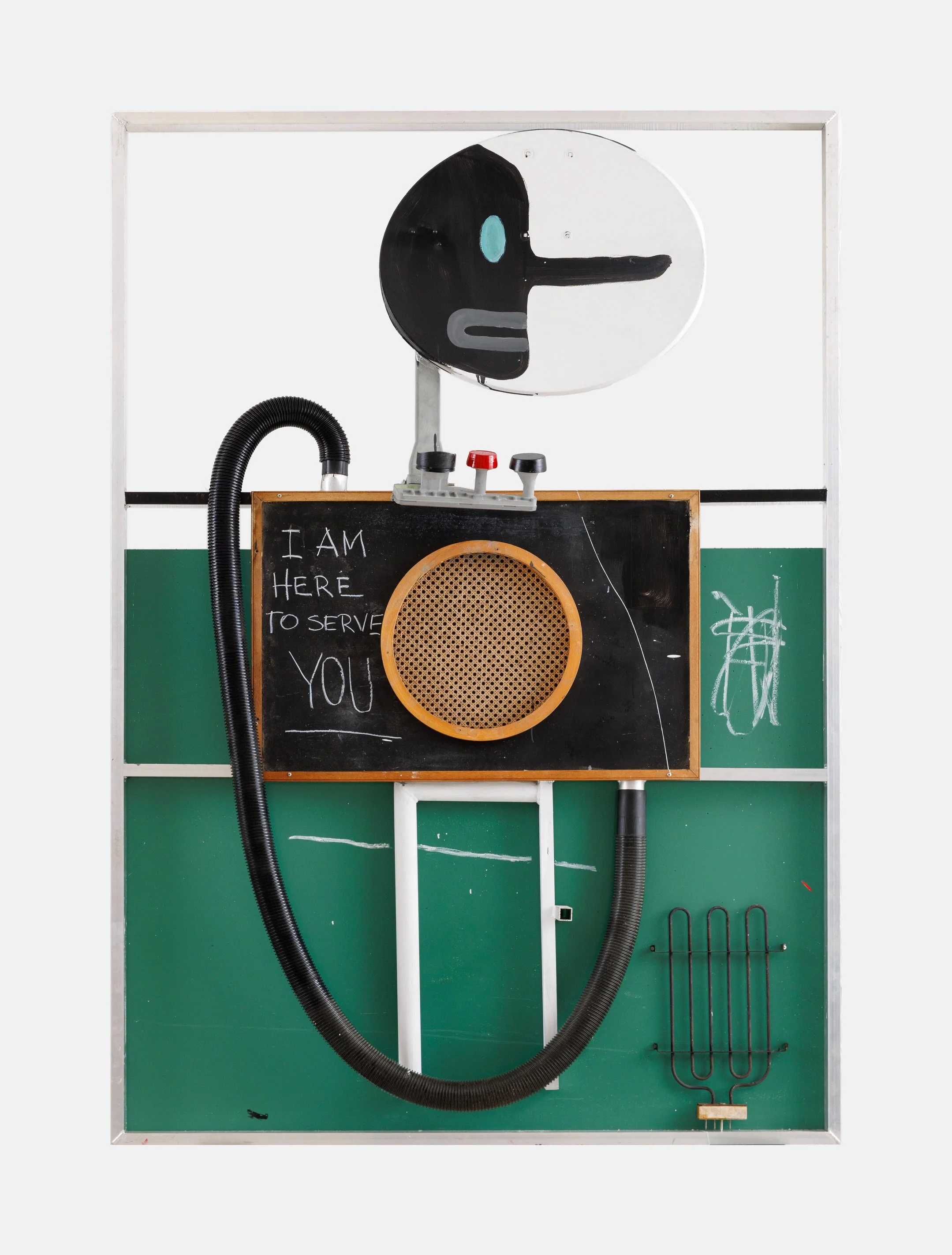
A.I. Teacher
Through your foundation and art therapy, you’ve used creative expression as a vehicle for mental health and community work. What can art do in that space?
MJ— Art is a language of expression, but it also cuts through artificial power structures shaped by the systems we live in. It resists conformity, challenges dominant perspectives, and allows us to move beyond everyday constraints whether laws, racial hierarchies, religion, or fixed cultural canons.
It has also been shown to have therapeutic value, particularly for those dealing with trauma. That’s why we support organizations that foster artistic expression in communities affected by trauma or disability. We are especially passionate about working with children early on, helping them discover their inner strengths.
Your work responds to long-standing systems, but those systems now feel more exposed and accelerated. How does your work evolve alongside that?
MJ— What were once local systems have expanded into global ones this is part of what colonization enabled, particularly the exploitation of people of color.
The internet, as a fast and far-reaching tool, allows information to be shared almost instantly and gives us the ability to act on that knowledge. Art allows me to respond to what I experience and feel, guided by intuition as a form of intelligence rooted in emotion and creativity just as academia provides structured knowledge.
Power has always relied on collective organization and action, yet that has consistently been met with suppression through fear. Today, in a global society, we must move toward more humane and collaborative systems to avoid further conflict driven by economic and racial divisions that benefit only a few.
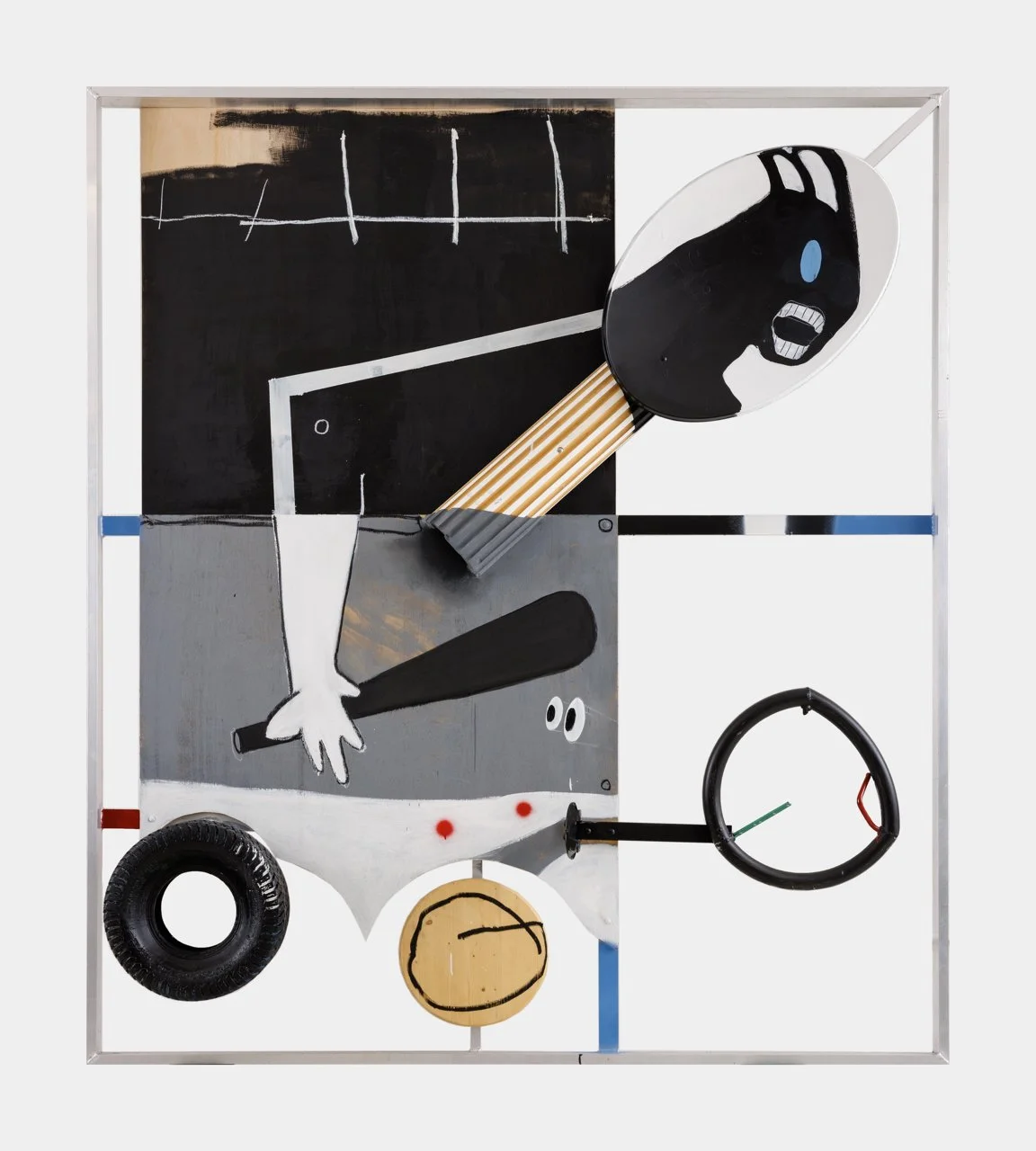
Oppressor and Oppressed
What does it mean to now find yourself written into the very history you have been interrogating?
MJ— It leaves me with a sense of hope that not all is lost at least not yet. Still, the control of narratives will remain an ongoing challenge. We must ensure that stories including my own are not rewritten, as history has often shown.
Alignment with like-minded, critical thinkers is essential for meaningful change. As we move forward, we must ask whether being human still holds the same value it once did, or whether technology is being framed as the next stage of human evolution—or even a transition into something else.
This is a moment where everyone should have a voice in shaping what comes next.
Additional Information:
Marcus Jansen website
Marcus Jansen Foundation
The Dichotomy of Art & Life: Marcus Jansen’s Victims And Victors at Almine Rech, London article by Gregory de la Haba
__
Images courtesy of Marcus Jansen.